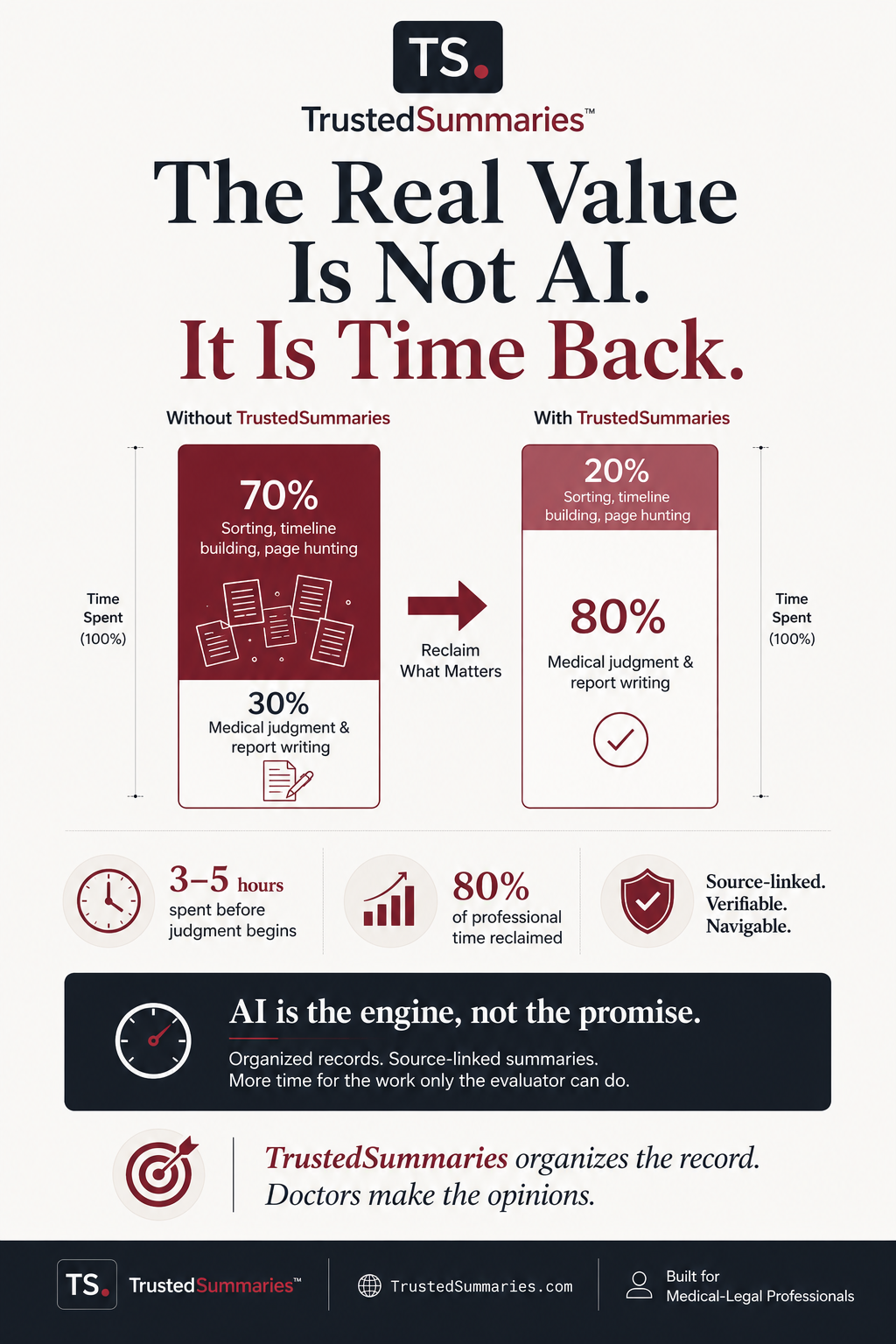
Everyone is talking about AI in medical-legal record review. But customers do not buy AI because it is AI. They buy a better workflow.
For QME, AME, and IME professionals, the real benefit is not a flashy claim about automation. The real benefit is fewer hours lost to sorting records, rebuilding timelines, searching for key treatment events, and reconstructing a patient’s treatment history from scattered PDFs.
That is the customer value TrustedSummaries by KaiAgentX is built to deliver: less time spent organizing the record and more time available for medical judgment, source verification, and report quality.
Customers do not need AI for its own sake
In med-legal workflows, AI is only useful if it reduces a real operational burden. A physician does not need another generic summary that sounds polished but still requires hours of checking, sorting, and navigation. A legal team does not need another disconnected output that creates a second document to audit.
The value comes when the technology removes friction from the work professionals already have to do: understanding the record, verifying key facts, identifying treatment patterns, and preparing a defensible report.
That is why the most important question is not, “Does this use AI?” The better question is, “Does this help the professional get to judgment faster, with better organization and clearer source visibility?”
The real cost is time lost before the medical judgment begins
In a typical medical-legal review, the physician’s judgment is the highest-value part of the process. But before that judgment can be applied, the record has to be made usable.
Large case files often include treatment notes, imaging, operative reports, work-status forms, prior injury records, duplicate pages, administrative documents, handwritten scans, and provider packets delivered out of order. The records may be complete, but they are rarely organized in the way a doctor needs to review them.
That creates hidden labor: sorting the file, identifying what matters, building a treatment timeline, finding the source page behind a key fact, and reconnecting events across months or years of care.
Those hours are not trivial. They are hours taken away from medical reasoning, careful source review, report drafting, and quality control.
Customer value means workflow relief
TrustedSummaries is designed around a simple idea: professionals should not have to spend their best time reconstructing the file before they can evaluate it.
A source-linked review packet gives physicians and support teams a more usable starting point. Instead of a raw, disorganized PDF stack, they receive structured summaries, source references, a navigable record packet, and an editable draft that can support report preparation.
The outcome is not “AI replacing work.” The outcome is workflow relief: fewer manual steps, faster orientation, easier verification, and less time lost searching through the record.
That is the kind of value customers can feel immediately. It shows up when a reviewer can find the relevant imaging faster. It shows up when a work-status change is easier to verify. It shows up when treatment history is already organized before the report-writing process begins.
More time for medical judgment, not less
The boundary matters. TrustedSummaries is not designed to replace the physician’s interpretation, findings, or final opinions. In medical-legal review, those responsibilities remain with the professional.
The goal is to protect more time for that judgment by reducing the lower-value work around it. When a record set is organized, searchable, summarized, and source-linked, the physician can spend more time asking the questions that matter: What does the treatment course show? Are the findings consistent? What changed over time? What requires closer review? What belongs in the final report?
That is a better use of professional time than manually hunting through hundreds or thousands of pages to rebuild the same timeline from scratch.
Better organization supports better report quality
Report quality depends on more than writing style. It depends on the reviewer’s ability to understand the full treatment history, verify important facts, and identify the medical events that matter most to the opinion.
A stronger workflow can support a stronger report because it gives the professional a cleaner foundation. The reviewer can see the chronology more clearly, locate source material faster, and spend more attention on analysis instead of document handling.
This is where the customer value becomes strategic. TrustedSummaries does not just make the record shorter. It makes the record easier to work with.
The positioning: AI is the engine, not the promise
AI may power parts of the workflow, but it should not be the main promise. The main promise is practical: organized records, source-linked summaries, faster orientation, and more time for the professional work that only the evaluator can do.
TrustedSummaries organizes the record. Doctors make the opinions.
That distinction is important for customers. It keeps the product focused on trust, usability, and professional control rather than automation for its own sake.
How to get started
The best way to understand the customer value is to try it on a real case or sample record set. See how much time is lost today to sorting, searching, timeline building, and treatment-history reconstruction — and how much of that work can be reduced with a source-linked review packet.
Experience the category KaiAgentX is building with your first 250 pages free.
Start with your first 250 pages free.
Reach out to us at trustedsummaries@kaiagentx.ai.