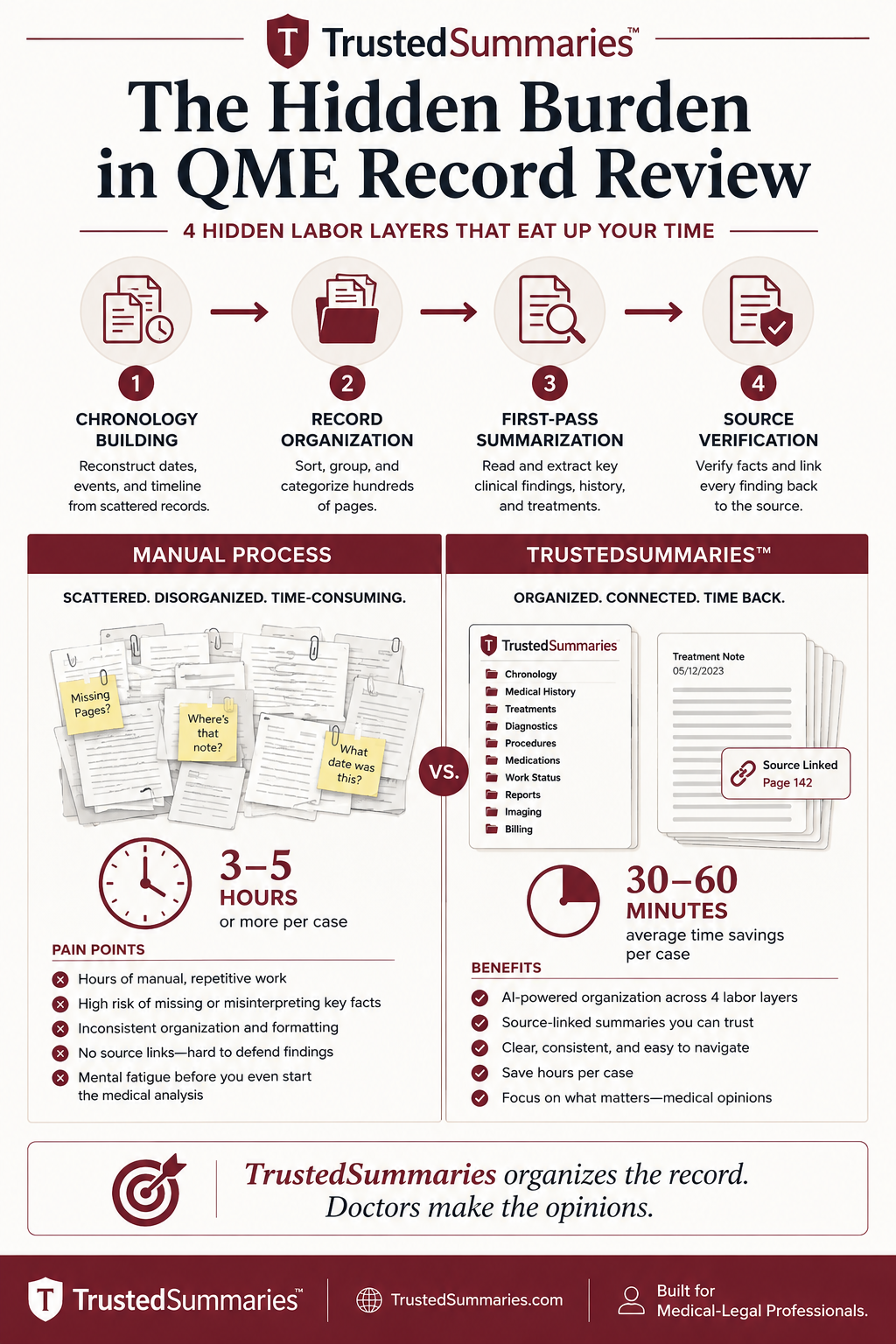
The first problem is not medical complexity
The first problem in QME record review is not always medical complexity. Often, it is the administrative burden hidden inside the record set itself.
Before a physician can evaluate causation, apportionment, work restrictions, permanent impairment, or future medical care, someone has to make sense of the documents. That work includes identifying the right records, building a useful chronology, removing noise, locating key events, and creating a first-pass summary that helps the evaluator prepare for report writing.
That burden is easy to underestimate because it does not look like clinical judgment. But in QME, AME, and IME workflows, chronology, organization, and first-pass summarization directly shape how efficiently and responsibly a case can be reviewed.
A good summary is not enough
Generic AI tools can look impressive when asked to summarize a short, clean document. But QME record review rarely happens in short, clean documents. It happens across hundreds or thousands of pages, often with mixed providers, duplicate records, scanned pages, handwritten notes, imaging reports, operative reports, prior injury references, work-status notes, and treatment gaps.
In that environment, the real standard is not whether a tool can produce one polished paragraph. The real standard is whether the output remains dependable across the full record set.
Dependable document processing means the output should be repeatable, structured, source-aware, and useful from the first page to the last. It should help the reviewer move through the record with confidence, not create another layer of text that has to be rechecked from scratch.
The hidden labor behind QME review
A large record set creates several layers of work before the physician even reaches the core medical-legal questions.
- Chronology building: placing injuries, treatment visits, imaging, surgeries, work-status changes, and prior conditions in the correct sequence.
- Record organization: separating relevant records from duplicates, administrative pages, unrelated documents, and low-value noise.
- First-pass summarization: giving the evaluator a structured view of what appears in the records before the physician applies judgment.
- Source verification: allowing important statements to be checked against the underlying page or record source.
When this work is done manually, it consumes time that could otherwise be spent on medical reasoning, report quality, and careful review of disputed issues. When it is done inconsistently, it can create downstream risk.
Why small record errors can change the direction of a case
In medical-legal review, an accuracy error is not just a typo. If a key fact is missed, misplaced, or summarized without the right source context, the case can appear to point in a very different direction.
Example 1: A prior shoulder MRI is missed. A worker presents after an industrial injury with shoulder pain, and the current record includes an MRI showing a rotator cuff tear. If the review misses an older MRI that documented pre-existing degenerative tearing, the case may appear to involve a new industrial injury rather than an aggravation or progression of a prior condition. That difference can affect causation analysis, apportionment discussion, and the way the physician frames medical reasoning in the report.
Example 2: A work-status change is placed on the wrong date. A treating physician releases the worker to modified duty on one visit, then removes the worker from work after a later flare-up. If those dates are reversed or collapsed into a vague summary, the record can suggest a different disability timeline. That may influence how temporary disability periods, treatment progression, and functional capacity are understood during the review.
These examples show why dependable output matters. The issue is not whether AI can write a paragraph. The issue is whether the workflow helps the physician see the right facts, in the right order, with the right source context.
Dependability is the new standard for QME document processing
For QME document processing, dependability should become the standard. A useful system should not simply generate a confident-sounding summary. It should produce structured output that holds up across long record sets and supports professional review.
That means the workflow should be:
- Repeatable: consistent from case to case, not dependent on a one-off prompt.
- Structured: organized around chronology, record type, and review needs.
- Source-aware: connected back to the record so key facts can be verified.
- Workflow-oriented: designed to reduce time spent sorting, searching, and rebuilding the file.
- Physician-centered: built to support medical judgment, not replace it.
This is where workflow relief becomes measurable. The value is not just a shorter summary. The value is less time spent reconstructing the record, fewer blind spots in chronology, easier verification, and a faster path from document intake to report preparation.
KaiAgentX’s view: workflow relief without replacing judgment
KaiAgentX believes the next stage of medical-legal document processing is not about replacing physicians with AI-generated conclusions. It is about giving physicians and reviewers a dependable first-pass workflow layer that makes the record easier to understand, verify, and use.
TrustedSummaries by KaiAgentX is built around that principle. It organizes records, supports chronology review, creates source-linked summaries, and helps move from raw document volume to a physician-ready review packet.
The physician remains responsible for interpretation, findings, and final opinions. The workflow should make that responsibility easier to carry by reducing the hidden burden of record organization.
TrustedSummaries organizes the record. Doctors make the opinions.
How to get started
The best way to understand workflow relief is to test it against a real record set. See how much time can be saved when chronology, organization, first-pass summarization, and source verification are built into the review packet from the start.
Experience the category KaiAgentX is building with your first 250 pages free.
Start with your first 250 pages free →
Reach out to us at trustedsummaries@kaiagentx.ai